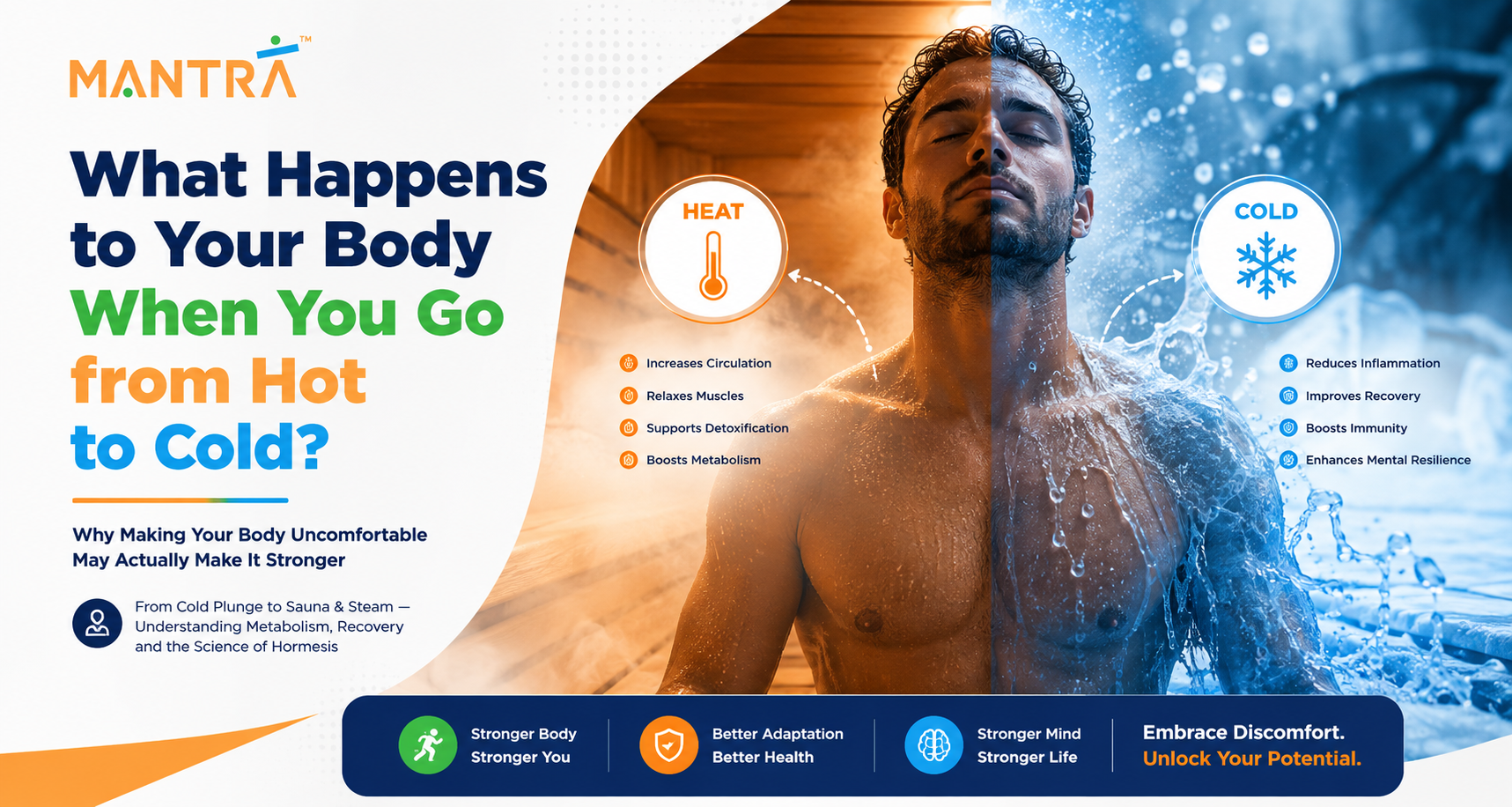
Why Making Your Body Uncomfortable May Actually Make It Stronger
From Cold Plunge to Sauna & Steam — Understanding Metabolism, Recovery and the Science of Hormesis
Modern life is designed around comfort. We live in temperature-controlled environments, sit on comfortable furniture, avoid extreme temperatures and often try to eliminate physical discomfort whenever possible.
But the human body is an adaptive biological system. When we give the body an appropriate challenge, it responds.
Exercise is perhaps the simplest example. We challenge our muscles, cardiovascular system and metabolism through exercise. We then recover—and the body adapts.
We become stronger. We become fitter. Our physiological systems become better prepared for the next challenge.
This fascinating biological principle is known as hormesis. And today, another form of controlled stress is attracting increasing interest:
Thermal Stress
Cold plunges, sauna and steam baths expose the body to different temperature environments and stimulate different physiological responses.
But what does this have to do with metabolism, recovery and long-term health?
Let’s explore.
Hormesis describes a biological phenomenon in which a small or moderate amount of stress can stimulate adaptive responses.
In simple terms:
Exercise is a classic example. The body is challenged. The body responds. Recovery follows. Adaptation develops.
Hormesis does NOT mean “the more stress, the better.”
The goal is not to overwhelm the body. The goal is to stimulate the body so that it can adapt.
When you enter cold water, your body immediately recognises the temperature challenge.
The sympathetic nervous system becomes activated and the body begins mechanisms designed to protect its core temperature.
One important response is thermogenesis—the production of heat by the body.
When you become cold, your muscles can contract rapidly to generate heat. Because muscle activity requires energy, energy expenditure increases.
The body can also generate heat without obvious shivering. One important contributor is brown adipose tissue, commonly called brown fat.
Brown fat contains mitochondria specialised for heat production. This is one reason cold exposure is interesting from a metabolic perspective.
The body is increasing its energy demand to defend its temperature.
A short plunge may increase energy expenditure, but that does not mean it will produce substantial fat loss.
The more interesting scientific question is whether repeated cold exposure can influence thermogenesis, temperature regulation and metabolic adaptation.
Research in this area is continuing.
Now let’s move to the opposite thermal challenge.
Instead of defending the body against cold, the body has to manage heat stress.
A sauna exposes the body to hot, generally dry air. As body temperature rises, the body activates its cooling systems.
Skin blood flow increases.
Blood vessels dilate.
Sweating increases.
Heart rate rises.
Circulation increases.
Thermoregulatory mechanisms become active.
The cardiovascular system therefore experiences additional physiological demand. This is a form of controlled heat stress.
Repeated heat exposure may help the body adapt to thermal stress and has been associated with cardiovascular and other health outcomes in observational research.
A person may weigh less immediately after a sauna because of fluid loss. That is primarily water loss—not equivalent body-fat loss.
Sauna should therefore never be promoted as a replacement for exercise or a weight-loss programme.
Steam bathing also exposes the body to heat, but there is an important difference:
A sauna generally provides dry heat. A steam bath provides heat with very high humidity.
Because evaporation of sweat becomes less efficient in humid conditions, the body can experience a significant thermal load.
Skin blood flow increases.
Heart rate may increase.
Sweating increases.
The body attempts to release heat.
Thermoregulatory mechanisms become active.
So steam bath also provides a form of controlled heat stress. But it is not exactly the same as sauna.
| Feature | Sauna | Steam Bath |
|---|---|---|
| Heat environment | Dry heat | Humid heat |
| Humidity | Relatively low | Very high |
| Main challenge | Heat stress | Heat + humidity |
| Sweating | Evaporation more effective | Evaporation less effective |
| Cardiovascular demand | Increased | Increased |
| Thermoregulatory demand | Increased | Increased |
| Experience | Hot and dry | Hot and humid |
The appropriate choice depends on the individual’s preference, tolerance, health status and purpose.
We can summarise the three experiences simply:
Cold → Sympathetic activation → Thermogenesis → Heat production
Dry heat → Vasodilation → Increased circulation + sweating → Heat regulation
Humid heat → Thermal load → Sweating + thermoregulatory response
They are different stimuli. They produce different physiological responses.
The body is challenged — and the body responds.
When most people hear the word metabolism, they immediately think:
“How many calories do I burn?”
But metabolism is much more than calorie burning.
A metabolically healthy body should be able to respond appropriately to changing demands.
A resilient metabolic system is not simply one that burns more calories.
It is one that can respond, adapt and return toward balance when physiological demands change.
One of the most inspiring examples of athletic longevity is Indian tennis player Rohan Bopanna.
At 43, Bopanna became the oldest men’s doubles World No. 1 and subsequently won the 2024 Australian Open men’s doubles title with Matthew Ebden.
His approach to recovery attracted considerable attention.
During the 2024 Australian Open, Bopanna explained that he had been taking an ice bath every day, after practice or after a match.
His explanation was simple:
“At my age, recovery is a major aspect.”
He also discussed the importance of physiotherapy, sports science and yoga in supporting his career.
We should not make the simplistic claim: “Rohan Bopanna won because of ice baths.”
There is no evidence to support such a conclusion.
The lesson is much more valuable.
Elite performance is not only about creating stress. It is also about managing stress and recovery.
Cold exposure was one component of Bopanna’s broader recovery strategy.
His story reminds us that as we age, recovery becomes increasingly important.
Before we become fascinated with cold plunges, sauna and steam, one thing should remain clear:
Exercise remains one of the most important tools for metabolic health.
The following information is intended as a general educational guideline for healthy adults, not an individual medical prescription.
Individual tolerance varies, and the operating instructions of the specific Mantra equipment should always take priority.
Longer is not necessarily better.
Because humidity is very high, steam can feel more intense than the temperature alone suggests.
You do not need to use all three in the same session.
For beginners, it is better to understand how your body responds to one thermal stimulus at a time.
There is no universal requirement for a particular sequence.
The appropriate approach depends on the person’s goal, training status, tolerance and health condition.
There is no prize for tolerating the most discomfort.
Cold-water immersion, sauna and steam bath create real physiological stress. They are wellness and recovery facilities—not medical treatments.
The temperatures and durations mentioned in this article are general educational starting ranges for healthy adults and should not be considered individual medical prescriptions.
Do not use these facilities if you are feeling unwell, intoxicated, significantly dehydrated or unable to safely monitor your own response.
Individuals with cardiovascular disease, uncontrolled hypertension, certain heart-rhythm disorders, a history of fainting, significant kidney or fluid-balance problems, pregnancy, acute illness/fever, impaired temperature sensation or regulation, or other significant medical conditions should consult an appropriate healthcare professional before using thermal facilities.
People taking medicines that affect blood pressure, heart rate, fluid balance or temperature regulation may also require individual medical advice.
Stop immediately and seek assistance if you experience chest pain, severe breathlessness, fainting, confusion, severe dizziness, significant palpitations or other concerning symptoms.
At Mantra, safety comes before duration, temperature or performance.
When in doubt, seek medical advice first.
Stimulate — Don’t Overwhelm.
The purpose of thermal exposure is not to prove how much discomfort you can tolerate.
The purpose is to provide a controlled physiological stimulus, followed by appropriate recovery.
At Mantra Life Style Health Club, we believe fitness should go beyond simply exercising for an hour.
A modern preventive-health approach should consider:
Our sauna and steam-bath facilities provide members with opportunities to experience controlled heat exposure as part of their broader wellness and recovery routine.
The purpose is not simply to sweat.
It is not simply to burn calories.
And it is certainly not about tolerating the most extreme temperature.
It is about understanding the body’s response to controlled challenges.
Perhaps the most important lesson from hormesis is not:
“Take a cold plunge.”
It is:
“Give your body the right challenge, at the right dose, followed by the right recovery.”
Challenges the body with cold.
Challenges the body with dry heat.
Challenges the body with humid heat.
Exercise challenges the body with movement and metabolic demand.
Recovery gives the body the opportunity to adapt.
And Rohan Bopanna’s extraordinary career reminds us of something important:
Longevity in performance is not simply about pushing harder.
It is about understanding your body.
Training intelligently.
Recovering intelligently.
And adapting intelligently.
At Mantra, we believe the future of fitness is not simply about how much you can do.
It is also about how well your body responds to what you do.
That is the deeper lesson behind hormesis, thermal stress and metabolic resilience.